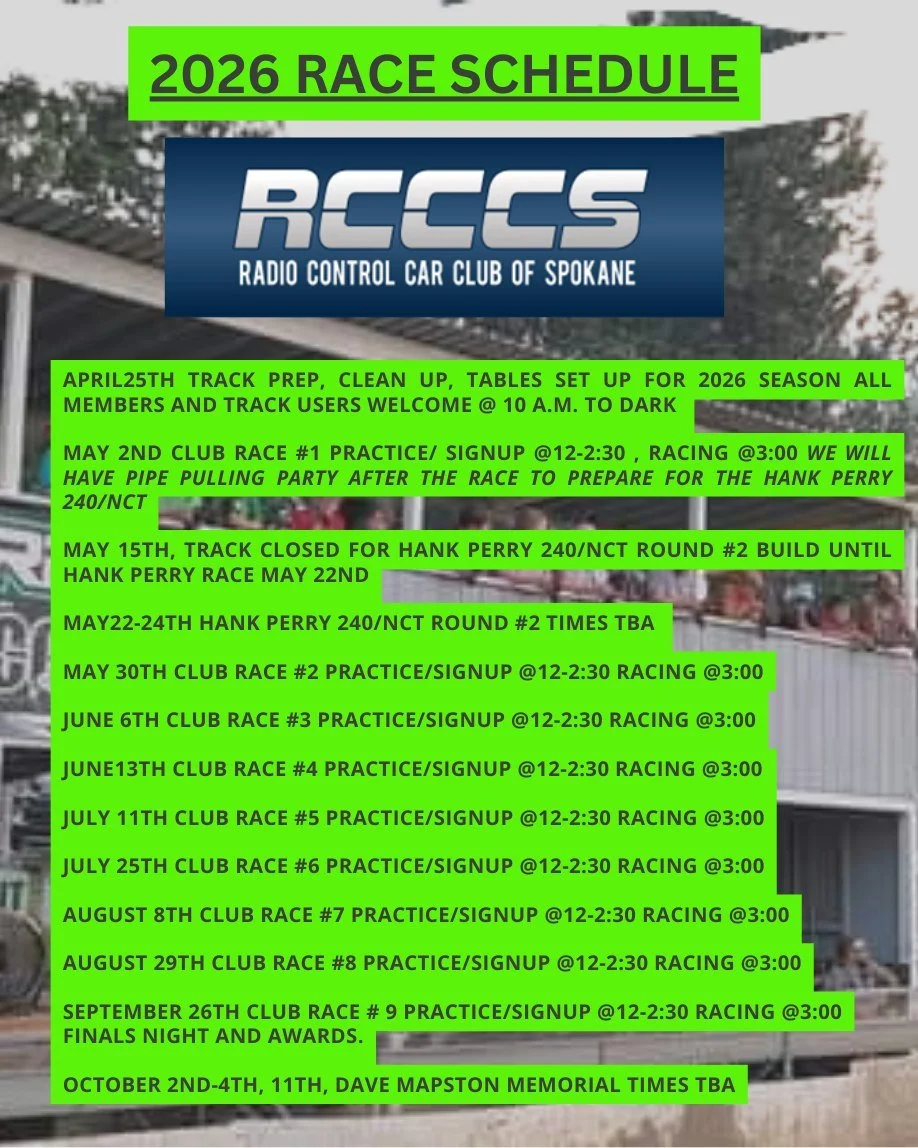
Start time:
- Signups close by 1:30 pm.
- Drivers meeting at 1:45 pm and mandatory for all racers.
- First race is on the track to start by 2:00 pm.
Classes offered:
- 1/8th Buggy Nitro
- 1/8th Buggy Electric
- 1/8th Truggy Nitro
- 1/8th Truggy Electric
- 1/10th 4wd Truggy
- 1/10th 2wd Truck (electric or nitro)
- 1/10th 2wd Buggy
- 1/10th 4wd buggy
- 1/10th 2wd Short Course
- 1/10th 4wd Short Course
- Novice (electric only) 2S Battery
Format:
- 1 Qualifiers for each class, 5 minutes in length
- Double A mains for electric, 8 minutes in length
- Single B mains for electric, 8 minutes in length
- Single A main for Nitro, 15 minutes in length
- Single B main for Nitro, 7 minutes in length
Club Race Fees:
Member -
1st class - $10.00
2nd class - $5.00
3rd class - $5.00
Non-Member -
1st class - $15.00
2nd class - $10.00
3rd class - $10.00
Novice:
$5.00
Additional Details:
- Personal transponders are mandatory for all racers
- Drivers meeting attendance is mandatory
- If you cannot make it to sign up before sign ups close, contact a friend or associate to help you get signed up.
- Novice racers can only run Novice, no second class
- Three class maximum
- We will do our best to make sure everyone that shows up, races, which means mixing some classes if needed.
- No alcohol or greens at club hosted activities or events.
- Safety is paramount – unsafe behavior or driving will not be tolerated.
- There will be no tolerance for verbal or physical altercations.
- Unsafe, erratic, and inappropriate driving, that makes an unsafe environment for the turn marshals will result in a stop and go the first time, and the second time you will be asked to pull your vehicle off.
- Zero launching into pit lane will be tolerated, before, during or following club race. First offense will be removal from that race. Second offense will be removal from the next schedule club race. Additional offenses could result in barring from any club hosted activities or offenses.
Club Racing Briefly Explained:
How to know what race you are in?
- For the qualifiers, there will be several sheets posted. These are called the heat sheets. These will identify what race number you race in and what fellow racers you race with. This list will be the same for the first and the second qualifier. Following the qualifiers, there will be a new set of sheets printed. These are called the mains. These will again, identify what race you race and what fellow racers your race with. Pay special attention to the order of names in your race. This will be the order in which you line up on the front straight to start your race.
Electric Qualifiers:
- From the time the clock stops, which is as soon as the last car crosses the line from the prior race, there will be just 2 minutes on the clock until the next race starts.
- This is enough time to get situated on the drivers stand, and take just 1 lap around the track.
- During your 1 lap, make sure you cross the loop so that you are checked in.
- Do not take another lap and do not go backwards down the straight
- After you have successfully checked in, immediately turn around and stage at the start of the front stretch in front of, not on, the loop.
- Please listen to the RD to make sure you are checked in properly.
- The RD will direct you on how and when to start your race.
- Electric classes use heads-up qualifying.
- When a faster car comes up on you, it’s best to take a wider line and let them past to avoid slowing eachother down.
- Race your qualifier and do not pull into the pits until the RD calls you by name and says you are done.
- Pull into the pits safely after your race to avoid impacting another driver who may not be done yet.
Nitro Qualifiers:
- From the time the clock stops from the prior race, there will be 3 minutes only on the clock.
- This is enough time to get situated on the drivers stand, and take a couple warm up laps to warm up the motors. If your motor requires more pre-heat, please pre-warm up the motors outside the main gate. Your pit guy can walk the running car into pit lane as soon as the last car has crossed the line from the last race.
- During qualifiers, the starting clock will be on live loop format. You will be on your own to make sure you are fueled up and well positioned to make sure you cross the loop before the first guy crosses the loop for the second time.
- Please listen to the RD to make sure you are checked in properly
- You are racing the clock, not each other
- When a faster car comes up on you, take a wider line and let them past, you are racing the clock, not them.
- Race your qualifier and do not pull into the pits until the RD calls you by name and says you are done.
- Pull into the pits safely after your race to avoid impacting another driver who may not be done yet.
Electric Mains:
- From the time the clock stops, which is as soon as the last car crosses the line from the prior race, there will be just 2 minutes on the clock until the next race starts.
- This is enough time to get situated on the drivers stand, and take just 1 lap around the track.
- During your 1 lap, make sure you cross the loop so that you are checked in.
- Please listen to the RD to make sure you are checked in properly.
- At the end of your first lap, do not full throttle down the front stretch, there will likely be other cars who have completed their lap and are lining up on the front stretch.
- After you have successfully checked in, begin staging in your starting box, which will be painted on the front stretch.
- You will line up in the order noted on your main sheet.
- The start for the mains is different in that as soon as the buzzer sounds, everyone goes at the same time.
- You are racing each other now.
- When a faster car comes up on you and is putting you a lap down, take a wider line and let them past.
- Race your main and do not pull into the pits until the RD calls you by name and says you are done.
- Pull into the pits safely after your race to avoid impacting another driver who may not be done yet.
Nitro Mains:
- From the time the clock stops from the prior race, there will be 3 minutes only on the clock.
- This is enough time to get situated on the drivers stand, and take a couple warm up laps to warm up the motors. If your motor requires more pre-heat, please pre-warm up the motors outside the main gate. Your pit guy can walk the running car into pit lane as soon as the last car has crossed the line from the last race.
- Please listen to the RD to make sure you are checked in properly
- After about 2 minutes, come into the pit for fuel and so that your Pit guy can carry you and your fuel out to the starting grid painted on the front stretch.
- You will line up in the order noted on your main sheet.
- Once all the pit guys are ready, the RD will call for final fuel.
- Once all the pit guys have final fueled, the RD will call for clean them out for a quick second. This is where you throttle up to clear out the engine.
- The RD will then call for down and quiet. Hit the brakes and let the pit guy put your vehicle in your starting box.
- The start for the mains is different in that as soon as the buzzer sounds, everyone goes at the same time.
- You are racing each other now.
- When a faster car comes up on you and is putting you a lap down, take a wider line and let them past.
- Race your main and do not pull into the pits until the RD calls you by name and says you are done.
- Pull into the pits safely after your race to avoid impacting another driver who may not be done yet.
Novice:
The Novice class is for entry-level drivers that are new to RC racing. The rules for this division are as follows:
• Chassis: Any 2wd or 4wd 1/10th electric off-road competition vehicle or 1/10th RTR vehicle with RTR electronics. "1/8th scale chassis will not be permitted." If the RD determines your times are similar to regular class lap times, you will be moved into the associated class.
• Motor: Any 1/10th scale brushed/brushless motor or the original RTR power system for your specific vehicle
• Batteries: 6-7 cell NiMH batteries, or 2-cell Li-Poly batteries. Max charge of 4.2v per cell.
• Tires: Any rubber tires are allowed.
• Bodies: Any body style is allowed.
• Minimum Weight: None.
2wd mod buggy:
• Chassis: Any 1/10th off-road 2- rear-wheel drive buggy style chassis.
• Motor: Any turn brushed or brushless, sensored or sensorless motor.
• ESC: Any sensored or sensorless electronic speed control.
• Batteries: 2-cell Li-Poly batteries. Max charge of 4.2v per cell.
• Tires: Any wheel with rubber tires intended for the class is allowed.
• Bodies: Any 2WD buggy body intended for the class.
4wd MOD Buggy:
• Chassis: Any 1/10th off-road 4-wheel drive buggy style chassis.
• Motor: Any turn brushed or brushless, sensored or sensorless motor.
• ESC: Any sensored or sensorless electronic speed control.
• Batteries: 2-cell Li-Poly batteries. Max charge of 4.2v per cell.
• Tires: Any wheel with rubber tires intended for the class is allowed.
• Bodies: Any 4WD buggy body intended for the class.
2wd Stadium/ Gas truck:
• Chassis: Any 1/10th off-road 2- rear-wheel drive Stadium truck style chassis.
• Motor: Any turn sensored or sensor less brushless or brushed motor. Or gas powered drive train is acceptable.
• ESC: Any electronic speed control
• Batteries: 2-cell Li-Poly batteries. Max 4.2v per cell.
• Tires: Any wheel with rubber tires intended for the class is allowed.
• Bodies: Any 2WD truck body intended for the class.
2WD Short course:
• Chassis: Any 1/10th off-road 2- rear-wheel drive Short course style chassis.
• Motor: Any turn brushed or brushless, sensored or sensorless motor.
• ESC: Any sensored or sensorless electronic speed control.
• Batteries: 2-cell Li-Poly batteries. Max charge of 4.2v per cell.
• Tires: Any wheel with rubber tires intended for the class is allowed.
• Bodies: Any 2WD Short course body intended for the class.
4WD Short course:
• Chassis: Any 1/10th off-road 4-wheel drive Short course style chassis.
• Motor: Any turn brushed or brushless, sensored or sensorless motor.
• ESC: Any sensored or sensorless electronic speed control.
• Batteries: 2-cell Li-Poly batteries. Max charge of 4.2v per cell.
• Tires: Any wheel with rubber tires intended for the class is allowed.
• Bodies: Any 4WD short course body intended for the class.
Mini Truggy 4WD:
• Chassis: Any 1/10th off-road 4-wheel drive Mini Truggy style chassis.
• Motor: Any turn brushed or brushless, sensored or sensorless motor.
• ESC: Any sensored or sensorless electronic speed control.
• Batteries: 2-cell Li-Poly batteries. Max charge of 4.2v per cell.
• Tires: Any wheel with rubber tires intended for the class is allowed.
• Bodies: Any 4WD Mini truggy body intended for the class. Truggy or Bruggy are ok.
8th Scale Nitro buggy:
• Chassis & Drivetrain: Must be 4-wheel drive (4WD) with a 1/8 scale buggy chassis.
• Engine: Maximum engine displacement is 3.5cc (.21 cubic inches). Engines must be 2-stroke and typically use a standard air filter.
• Fuel: Standard nitro-methane/methanol/oil blend.
• Tires & Wheels: Any rubber tire/wheel designed specifically for 1/8th scale buggy racing is allowed.
• Body: A 1/8 scale nitro buggy-specific body is required.
• Safety/Electronics: A 3rd channel is often required for the transponder. Failsafes are mandatory to stop the car if radio signal is lost.
8th scale eBuggy Open/ Sportsman:
• Chassis: 1/8 scale 4WD electric buggy chassis, or converted 1/8 nitro chassis.
• Motor/ESC: Any 1/8 scale electric brushless motor and ESC.
• Battery: No more than a 4S LiPo (14.8V) maximum. Max charge of 4.2v per cell. Hard case is required for safety purposes.
• Tires: Any rubber tire/wheel specifically designed for 1/8 scale buggy.
• Body: Any 1/8 scale nitro or electric buggy body.
• Club level racing: If you finished in the top 5 overall in the previous, former seasons, or longer than 3 years in racing eBuggy, you will be required to run in the Open eBuggy class.
8th scale eTruggy:
• Chassis: 1/8 scale 4WD electric tuggy chassis, or converted 1/8 nitro chassis.
• Motor/ESC: Any 1/8 scale electric brushless motor and ESC.
• Battery: No more than a 4S LiPo (14.8V) maximum. Max charge of 4.2v per cell. Hard case is required for safety purposes.
• Tires: Any rubber tire/wheel specifically designed for 1/8 scale truggy.
• Body: Any 1/8 scale nitro or electric truggy body.
Keep in mind, the only times these rules will change are during ROAR sanctioned events. Please read their guidelines. They have specific rules regarding things such as approved batteries, bodies, electronic speed controls and motors.